

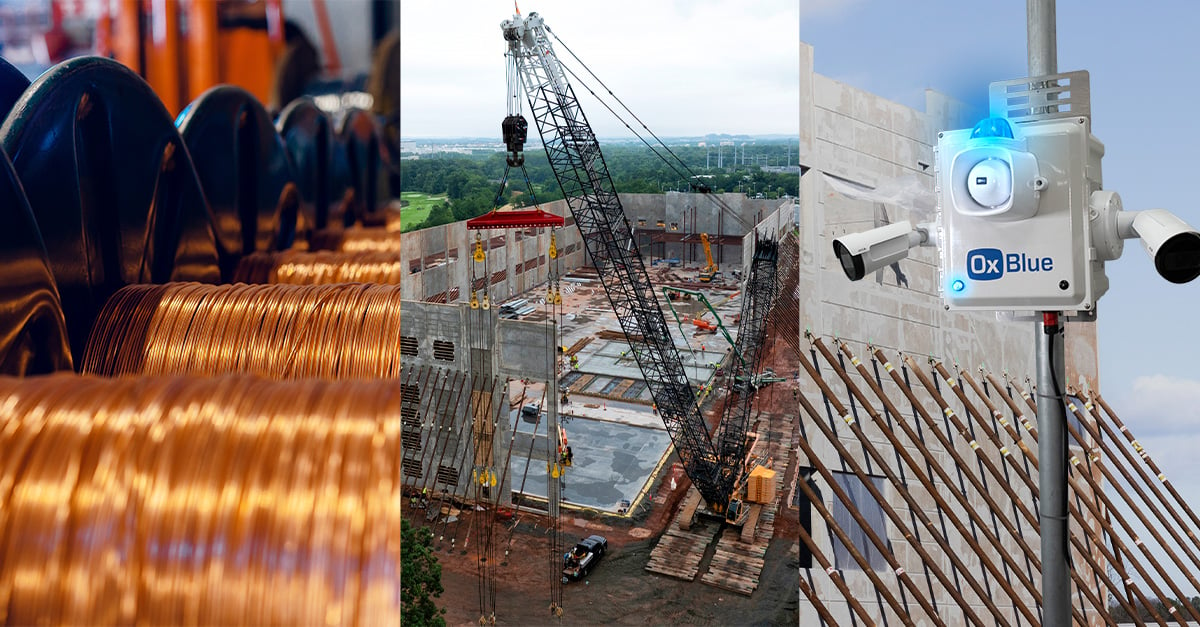
The physical infrastructure powering the AI boom is most vulnerable when it doesn't yet exist as a building. It exists as copper wire spooled across a fenced lot in the middle of nowhere. That's where the real exposure is — and it's where most security programs aren't hitting the mark.
The numbers make the case.
AT&T recorded more than 10,400 copper theft incidents nationwide in 2025 — roughly 200 a week — with losses exceeding $82 million. NPR's reporting from June 2026 documented how organized crews using heavy machinery now hit the same lines multiple times in coordinated thefts, not opportunistic strikes. California alone saw 4,300 incidents in 2025, up from 71 in 2021, and copper prices climbed more than 30% on data-center-driven demand. The same people targeting telecom networks know what's sitting at a half-finished data center site after dark. Construction sites typically have weaker perimeter coverage than utility right-of-way, and crews don't return until 6 AM.
What the standard security model misses
The site is at its most asset-rich exactly when its security posture is at its weakest — a gap that runs 18 to 30 months on a typical build, longer on hyperscale campuses.The commissioning handoff compounds it. When responsibility shifts from the GC's site team to the operator's security team, there's a window where neither side fully owns the building. Equipment is installed but not energized. Restricted areas exist on paper but aren't enforced. This is where liability gaps emerge and security coverage falls through the cracks. A construction camera system in place from groundbreak to go-live closes that gap — it becomes the one unbiased, continuous record that neither side can dispute.
What makes a construction security camera tamper-resistant
A tamper-resistant construction security camera is a jobsite camera built to keep operating — and keep transmitting — when someone is actively trying to disable it. On a data center build with $100M+ of equipment staged on site, that means four things: an anti-tamper enclosure that resists cutting and prying, battery backup that keeps the camera running if site power is cut, built-in cellular connectivity so a severed jobsite network doesn't blind the system, and onboard storage so footage of the tampering attempt itself survives the attempt.Most consumer and IT-surveillance cameras fail at least one of these. They depend on jobsite Wi-Fi or wired networks. They lose power when the site does. They store footage to a local NVR sitting in the same trailer a thief is about to break into.
OxBlue is built for this environment specifically. Here's how it compares to the alternatives most data center teams evaluate:
| CAPABILITY | OXBLUE SECURITY SYSTEM | TYPICAL IP SURVEILLANCE CAMERA | CONSUMER-GRADE / DI / DOORBELL CAMERA |
| Anti-tamper enclosure | Yes, built into mounting cabinet | Varies; rarely jobsite-rated | No |
| Battery backup | Optional | Requires separate UPS | No |
| Cellular LTE built-in | Yes, all cameras | No; requires site network | Wi-Fi only |
| Onboard storage | 128GB+ per camera | Depends on NVR | Cloud-only; Wi-Fi dependent |
| AI-Filtered motion alerts | Yes, trained on construction sites | Generic motion detection | Generic motion detection |
| Professional monitoring | UL-Certified, 5-Diamond, TMA-Member | Optional | No |
| Builder's Risk Insurance Compliance | Meets Highland, TRU, Travelers, Intact, USI and more | Varies | No |
| Solar-compatible | Yes, purpose-built systems | Rare | No |
This matters at the platform level, not just the camera level. A data center build runs 18 to 30 months. The camera installed on day one has to still be working in year three, in temperatures from -40°F to 122°F, on a site that has lost grid power more than once. OxBlue has monitored 51,000+ projects across all 50 states and 45+ countries since 2001, and is part of Hexagon — which is less a brand argument and more an answer to the question every procurement team eventually asks: will this vendor still be supported in 2028?
Most security camera vendors sell hardware. OxBlue delivers the full visibility layer — hardware, cellular, cloud storage, AI, professional monitoring, and US-based support under one contract. On a project this size, that's the difference between one accountable vendor and a finger-pointing exercise when something goes wrong at 2 AM.
What a construction-stage program actually has to do
Perimeter coverage that works after hours. Most overnight incidents get discovered the next morning, when the evidence is gone and the equipment is already on a truck. The difference between a deterrent and a documentation exercise is whether someone is watching when the motion alert fires at 2 AM. AI-filtered alerts suppress wildlife and weather false positives, and UL-Certified, 5 Diamond, TMA-Member agents verify threats and dispatch police when something actually fires.
Daytime visibility into who's on site and what they're doing. On a 200-acre hyperscale campus with six buildings going up simultaneously and dozens of subcontractors cycling through, this is the harder problem — and where insider-driven shrinkage concentrates. Weekly site visits and emailed photo reports don't move fast enough. By the time a project manager knows where a crew is or isn't working, the window to act has already closed.
A defensible visual record of every day of the build. The same time-stamped archive that resolves a "the generator pad wasn't ready" dispute also resolves a "this transformer arrived damaged" dispute and a "we don't know when the copper was cut" police report. It supports insurance claims, commissioning verification, and the chain-of-custody questions that surface at handoff — the one document neither side can manufacture after the fact.
The multi-project dashboard makes this scalable across a portfolio. A hyperscale operator running 12 active builds across Northern Virginia, Dallas, Phoenix, and Chicago needs one platform, one view, and a consistent record — not 12 different security programs stitched together across markets with different power profiles, labor conditions, and threat environments.
The AI infrastructure conversation focuses on what gets built. The construction-stage security conversation is about whether what gets built stays built — from the day equipment arrives on a truck to the day the operator's badge readers go live. That's a two-year window, on every project, and it's where the most consequential physical security decisions in this space are being made right now.
The teams getting it right aren't waiting until after the first incident to find out their camera system can't survive a cut power line or a severed network cable. They're specifying for the threat environment that actually exists: organized crews, coordinated returns, high-value copper sitting in the open for months before permanent security goes live.
If you're scoping security for a data center build that breaks ground in the next 12 months, three questions are worth answering before the contract goes out:
- Will the cameras keep transmitting if site power is cut or the network is severed?
- Who is actually watching the alerts at 2 AM, and how fast can they dispatch?
- Will the footage of a tampering attempt survive the tampering attempt?
If the answers aren't clear, the security program isn't built for the site it's protecting.
Talk to OxBlue about your next data center build. We'll walk through the four-force visibility framework with your team, review your site plan, and show you what a tamper-resistant deployment looks like at the project scale you're working in.