

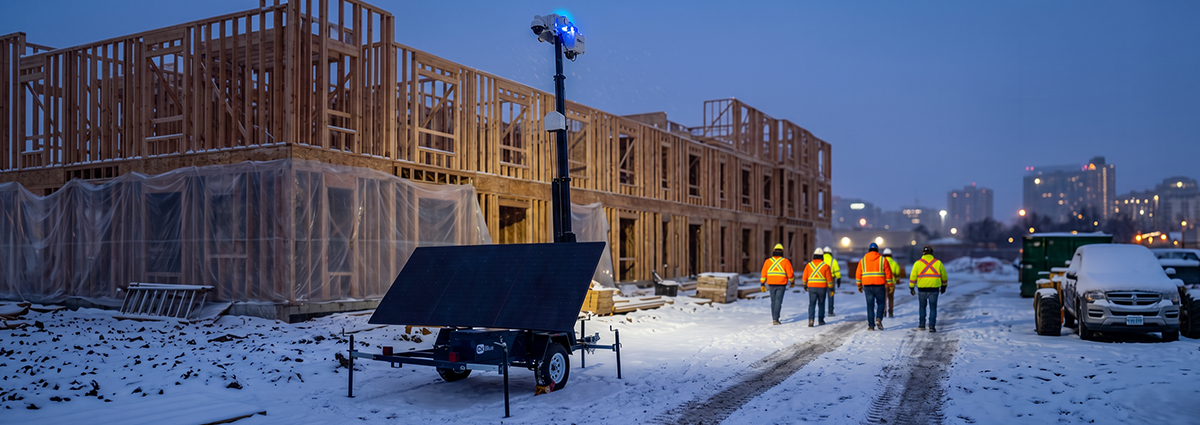
Twas the weeks before the holidays, and all through the site,
not a machine was stirring, not a truck in sight.
The cranes hung high, strung up all with care,
protected by the strobe light that was there.
It’s the season to start writing your own holiday jingles as you and the crew get ready to take a break and spend time with friends and family. Per usual, that also means making rounds on site to reduce the risk of theft. The National Equipment Register waves a red flag between December 23 and January 2, when millions in equipment losses pile up. Ryan Shepherd of risk management company Verisk, which runs the NER, put it plainly years ago and it still rings true: “Thieves know the crews are leaving on a Thursday night and not coming back until Tuesday.”
As the advent calendar of security risks begins, run this anti-theft plan and checklist on your construction site.
Two weeks out: handle anything that needs a lift or a lead time
Start two weeks out with anything that cannot be fixed from a phone. Repointing a camera takes a person on a lift, and adding coverage takes ordering lead time, whether that means a mobile surveillance trailer for an off-grid corner of the site or more fixed cameras on a blind fence line.
☐ Walk every camera view in daylight. Sightlines drift over a long project, material stacks move, walls go up, and there’s rarely a change order for adjusting the camera view.
☐ Decide now whether you want professional monitoring over the break. Self-monitored alerts still leave someone awake at 2 a.m. deciding whether this one is worth a call to the police. Professional monitoring runs $95 a month per camera and puts certified agents on that decision instead of your super.
☐ Record what’s staying on site. Serial numbers, PINs, and photos belong somewhere other than the jobsite trailer, since the trailer is on the site too. At a 22% recovery rate, identifiers are most of what anyone has to work with.
☐ Check whether a coverage gap needs hardware instead of an adjustment. A corner with no power and no fence needs a mobile surveillance unit, which is a procurement conversation, not a support ticket.
The last week: test every camera after dark
The week before the break is for night testing.
☐ Test every camera after dark. NER’s holiday guidance is to confirm you are getting usable images of license plates, faces, and vehicles, not just proof that the camera is on. Stand where an intruder would stand and pull the live feed up on your phone.
☐ Reset PTZ presets for the shutdown rather than the workday. When nobody is streaming, the camera cycles through four preset views every few minutes. Point those at what is staying on site instead of at the crane.
☐ Check solar panels and battery charge, and clear any debris while you’re up there. Batteries carry roughly five days of average backup, which covers a cloudy stretch but does nothing for a panel under snow.
☐ Set monitoring hours to cover every night of the shutdown. Weeknight-only schedules are the most common gap, and the break is mostly not weeknights.
☐ Update the alert list. Names go stale faster than hardware does. Pull anyone who rolled off the project, add the owner’s rep if they want in, and check the numbers that changed in the fall.
☐ Confirm the call protocol for a verified threat. Write down who gets called, in what order, and what happens when the first two don’t answer.
The last day: stage the site and the equipment inside camera view
Staging is the difference between a camera that records a theft and one that records a spoil pile. Equipment parked outside camera view is equipment nobody is watching, and the panels powering an off-grid security unit need a clear face going into eleven days without a crew on site. OxBlue trailers are built to stay up through that window: powder-coated steel frame, reinforced cut-resistant cable reel, and lockable cabinets for the battery and storage.
☐ Park equipment and materials inside camera view. A dozer behind a pipe stack or on the far side of the spoil pile is a dozer nobody is watching.
☐ Close the access points your cameras don’t watch. Every gate you chain is one less angle to cover.
☐ Check that the tamper-resistant hardware is actually secured. Cabinets locked, cable reel seated, mast at its lockout height.
During the break: decide who checks the feed before anyone needs to
☐ Name who checks the feed and how often. “Somebody will look” means nobody looks on December 28.
☐ Share access with everyone who needs it.
☐ Name someone to clear the panels after a storm.
When crews return: compare, review, and document before you report
Once you’re back, if you didn’t have monitoring through the holiday break, take a site walk for documentation. Side-by-side comparison against your last pre-break image makes a missing pallet obvious in seconds, and timestamped footage from the OxBlue archive is the first thing an insurance adjuster asks for after a construction theft.
☐ Compare the site against the last image before the break. Side-by-side view makes a missing pallet obvious in seconds.
☐ Review every alert clip from the shutdown, including the ones that never rose to a dispatch. The same vehicle slowing at the gate on three different nights only shows up when you look at them together.
☐ Report anything missing immediately, with footage attached. Peachtree Hotel Group used OxBlue footage to establish the time of an incident and capture the make, model, and license plate of the vehicle involved.
For owners and developers: what to ask your GC before the site empties
Three things belong to the owner rather than the site team, and all three are harder to get once the trailer is locked and the crew has scattered:
-
a camera map,
-
your own web app access,
-
and documented proof of monitoring if a lender or insurer wants it.
Ask your general contractor for a camera map showing which zones are covered. Ask for web app access, so you can look at the site yourself over the holidays instead of waiting on a Monday email. And if your lender or insurer wants documented proof of monitoring, request it before the trailer locks up.
Checklist to tape inside the trailer door
☐ Walk sightlines in daylight
☐ Test every camera after dark
☐ Set monitoring hours for every night of the break
☐ Update the alert list and confirm the call protocol
☐ Clear solar panels, check battery charge
☐ Park equipment and stage material inside camera view
☐ Lock cabinets, seat the cable reel, chain the gates you aren’t watching
What OxBlue monitors while your crew is off site
OxBlue monitors camera health and power on the backend through the shutdown. A battery sliding toward empty under a week of overcast shows up on OxBlue’s side, not on January 2 when someone notices a blank tile in the dashboard.
Connectivity is covered in a different way. Each camera records up to 128GB of onboard storage first, which holds roughly two weeks of video, and uploads from there over built-in cellular LTE. If the carrier signal drops on December 27, the camera keeps recording to the card and sends the backlog once the connection returns, so an outage costs you upload time instead of footage.